Route 9
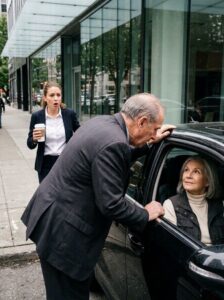
Amanda stood on the sidewalk with coffee soaking through her white blouse and said, “Mom, I can explain.” Tom Harlan didn’t look at her. He opened my car door himself and offered his arm.
“Mrs. Kessler. The lobby has very good chairs. I’d like you to try one.”
I took his arm. My knees complained on the way up. Behind us, my daughter’s heels clicked once on the pavement and stopped.
My name is Dorothy Kessler. I’m seventy-six. I taught fourth grade in the Route 9 district for thirty-one years, and for forty-two I kept the books on an eighty-acre farm in central Ohio, in a ledger with a green cloth cover. I have never owed anyone money, and I have never been in a hurry.
Walt and I bought the farm in 1974 for $41,000. He grew corn and soybeans and kept a small herd of Angus. He died in March of 2016, of a stroke, in the barn, with a bucket of feed in his hand. We were married forty-four years. The tractor is still in the shed. I mow with it every week, and I talk to him while I do.
Amanda is thirty-eight. She is our only child. She is tall and quick and exactly as bright as everyone told her, with Walt’s jaw and a smile she can turn on like a porch light. She works in acquisitions for Harlan Brandt Development, which builds shopping centers. She calls the farm “the property.” She calls me “Mother” when coworkers are near.
I want to be fair to her, because I wasn’t always. She left for Columbus at eighteen with a scholarship and a determination I envied. She came home at Christmas in better coats each year. She never stopped loving me. She just got ashamed of the place she came from, a gravel road, a mud room, a mother in a barn coat. She’s been trying to outrun it for twenty years.
You know about the doctor’s appointment. Amanda offered to drive me. It was a kindness. She said she needed to “stop by the office” first, and parked in front of a glass building with a fountain.
Mom, just wait here. My boss doesn’t like older people hanging around the lobby.
I said all right. I’d waited out droughts. I waited forty minutes with a thermos and a crossword, and watched young people in lanyards walk past my window without looking.
Then Tom Harlan knocked on the glass.
The lobby was white marble and steel. A receptionist looked up and her face went carefully blank. Tom walked me past her to a leather chair beside a model of the project, a long table under glass, a miniature world of tiny roofs and green felt lawns. I stood a minute and looked.
In the exact center, a little brown square had been left blank. A single patch of unpainted wood, eighty acres at scale.
“That’s you,” said Tom.
“I know.”
“Everything else, we own. We’ve owned it for two years.” He rubbed his eyes. “I keep the model out so I’ll remember what it costs to be told no.”
I sat. He sat across from me, a tall, silver-haired man in a gray suit, with a tired, decent face. A lanyard hung crooked around his neck.
“Mrs. Kessler. I’d like to tell you why I wrote eleven letters. I’d like it to be the truth. Is that all right?”
“I’d prefer it.”
He told it plainly. Harlan Brandt had bought the surrounding parcels one at a time, through brokers, at fair prices. Every neighbor sold. The Millers, the Odoms, old Gus Teague on the creek, all took the money and went to Florida. The plan was a mixed-use center, a hospital annex, eleven hundred homes, a school.
“And in the middle, your farm,” said Tom. “Cut it out, and the road doesn’t connect. The sewer line can’t run. The whole thing collapses.”
“I know. I’ve seen the maps.”
“You’ve seen the maps?”
“Amanda left them on my kitchen table last Thanksgiving. Folded in her purse.”
He stared. “She left them.”
“She didn’t mean to. She meant to scare me, I think. She said, ‘Mom, the county’s going to take it anyway. Eminent domain.’” I smiled. “It isn’t true. I looked it up. A private developer can’t.”
Tom put a hand over his mouth. A laugh came out of him, rough and astonished.
“She told me you were ready to sell,” he said. “In March. She said she was ‘working on you.’”
The receptionist appeared with two cups of tea. She set them down very quietly and left. I held mine. It was good tea.
“Mrs. Kessler,” said Tom. “I’m going to say something unflattering about my own company.”
“Go ahead.”
“Six years ago, I hired a young woman out of Ohio State. She was the best I’d ever seen. She read a title commitment like a novel. She found a boundary error that saved us a million dollars. I promoted her three times.” His voice cracked slightly. “She was so hungry, Mrs. Kessler. I thought it was ambition.”
“It was.”
“It was also something else.”
“Shame,” I said.
He looked at me. “How did you know?”
“I raised her.”
He nodded slowly. He set down the cup.
“Last month, in a meeting, she said something about the owner of Route 9. I’d like to repeat it. Not to wound you. So you know what I heard.”
“I think I can guess.”
“A stubborn old woman with no family who’ll probably die before she sells.”
I turned the cup in my hands.
“I’m not offended,” I said. “Not exactly. I’d like to understand how a girl I taught to read at the kitchen table came to say it.”
“I’d like to know, too.”
“Is she in trouble?”
He took a long time. “That’s the question I came out to the parking lot with, in a manner of speaking. I’d planned to discuss a deal with you today. I hadn’t planned to discuss my own employee.”
“But?”
“But she also did something worse than what she said.” He looked at the model, at the blank square. “Mrs. Kessler, did you ever sign anything?”
“I haven’t signed anything for the company.”
“Did anyone else sign for you?”
I set down my tea.
“I’d like to show you a document,” said Tom. “I’d prefer you read it before you answer.”
He went to a desk by the window and returned with a folder. He put it in my lap. It was a brown file, three inches thick, labeled ROUTE 9 — KESSLER PARCEL — ACQ.
I put on my glasses. It took me a moment to find the page. He’d flagged it with a yellow tab.
It was a Purchase Option Agreement. Optionor: Dorothy A. Kessler. Optionee: Harlan Brandt Land Holdings LLC. A price of $2,600,000, a closing date in six weeks, and, on the last page, my signature.
I make my D like a barn door, a flat top with a stiff curve. This one had a loop.
Beneath it, a notary’s stamp from a woman named Gladys Pruitt. And a date, eleven weeks earlier. A Tuesday in March.
I held the page at arm’s length and read it three times.
“Tom,” I said. “I was at my sister’s in Dayton that Tuesday. For a funeral.”
He closed his eyes.
“I was afraid you’d say something like that.”
For a time neither of us spoke. Out the window, a man in a gray uniform was watering the fountain’s planters.
“Who brought you this?” I said.
“It was in the file. Filed under the acquisitions team. The notary’s a name I don’t recognize.” He sat down heavily. “It was submitted for my signature last Friday. Closing instructions, wire details. A title company was already engaged.”
“But you didn’t sign.”
“I couldn’t. I had a feeling. The price was too good.” He rubbed his face. “Sixty percent over my last offer. A woman who’d said no for two years wouldn’t say yes at that number on a Tuesday.”
“She’d say yes if she were told it was done.”
“Yes.”
“Amanda,” I said.
I hadn’t meant to say her name. It came out of me like a swallowed stone.
“I don’t know that,” said Tom. “I’d like to be careful. A forged document in a file doesn’t have a name on it. I’ve asked our general counsel to look into who accessed it.”
“You haven’t asked her.”
“I haven’t. I wanted to talk to you first.”
I took off my glasses. My hands were quite steady. I’d learned it in the barn.
“Thank you for that,” I said.
The door at the end of the lobby opened. I knew her step. I’d have known it in a crowd of thousands.
Amanda came across the marble in her stained white blouse, with her badge swinging and her coffee gone. She’d done something to her face in the restroom. Her eyes were very bright and very dry.
“Mom,” she said. “I’m so sorry about the wait. Tom, I hadn’t realized you’d met.”
“We’ve met,” said Tom.
“I should have introduced you. I was, I got caught on a call.” She smiled. It didn’t hold. “Mom’s a little hard of hearing. She sometimes.”
“Amanda.”
“Yes, Tom?”
“Sit down.”
She sat. She took the chair beside mine, very straight, with her hands in her lap. She didn’t look at me.
“We need to talk about the Route 9 option,” said Tom. “I have a copy of the signed agreement. I’d like you to tell me how it was executed.”
I watched my daughter’s face. I’d watched it learn to smile. I’d watched it learn to lie, at nine, over a broken lamp.
It did nothing at all. It went smooth, like glass.
“Tom,” said Amanda. “I think you’d want to discuss this privately.”
“I think I’d want to discuss it in front of the person whose name is on it.”
“My mother’s confused. She’s, with her age, she doesn’t always remember what she’s signed. We went over it in March. She was thrilled.”
“I was at a funeral in March,” I said.
“Mom.”
“A Tuesday. The ninth. My sister Ruth’s husband.”
“You went to Ruth’s on the tenth.”
“I went on the eighth. I came home on the eleventh. I have the bulletin.” I took it from my purse. It was a folded program, soft from handling. “It’s dated.”
Amanda looked at it. She didn’t take it.
“I think you’re misremembering,” she said, very gently. “I think it’d be better if we, Tom, I’d like to suggest a medical evaluation. For her protection.”
The word hung in the air between us. Evaluation.
I’d read about it in a magazine at the dentist’s. I’d never thought it would come out of my own child.
I want to say what I felt. I’d thought I’d feel anger. What I felt was a long, slow sinking, like finding a crack in a foundation you’d been sure of.
“Amanda,” I said. “Look at me.”
She did.
“I’ve never been confused a day in my life.”
“You’re seventy-six.”
“I’m seventy-six. I ran a classroom of thirty children for thirty-one years. I balanced a farm’s books through two droughts and a flood. I did your taxes at the kitchen table until you were twenty-six.” I kept my voice level. “I know what I signed. I know what I didn’t.”
“Mom, please. Not here.”
“Where, then?”
“At home. Privately.”
“You told me to wait in the car.”
She flinched. It was the tiniest movement, a flicker, like a candle in a draft.
“You said your boss doesn’t like old people in the lobby.”
“That’s not what I said.”
“It’s exactly what you said. I have it in my head. I have a very good head.”
Tom Harlan shifted. He said, quietly, “Amanda. I’ve never said that. Not once.”
She didn’t answer. For a moment she looked, I thought, about nine.
It was Tom who spoke next. He’d folded his hands on his knee. His voice, which had been courteous, went very gentle, which is worse.
“Amanda. I’d like to ask you something. And I’d like it to be honest.”
“Of course.”
“Did you sign your mother’s name?”
The lobby was silent. A phone rang somewhere and was answered. The fountain outside made its small, steady sound.
“I want a lawyer,” said Amanda.
“You may have one.”
“I’d like to speak to her. Alone.”
“That’s your mother’s choice.”
She turned. Her face was white and stiff, and her eyes had gone wide and wet. “Mom. Please.”
I looked at my daughter. I thought of a girl on the porch swing in 1993, reading Charlotte’s Web aloud, with her feet on the rail and the whole hot summer going on around her.
“Tom,” I said. “Is there a quiet room?”
It was a small conference room on the second floor, with a long table, a window over the parking lot, and a pitcher of water. Tom showed us in, and left, and closed the door. We sat across from each other. Amanda didn’t take off her badge. I took off my coat.
For a long minute, we said nothing. I could hear a clock somewhere and a printer.
“I didn’t forge it,” she said at last.
“All right.”
“Mom, I swear.”
“Who did?”
She put both hands on the table. Her nails were perfect. “It was a, I had a junior analyst. He’s been, he wanted to prove himself. He prepared the packet. I never looked at the signature page.”
“His name?”
“Dennis. Dennis Reyes.”
“I’d like to meet him.”
“He’s, he left the company. In April.”
“Convenient.”
She pressed her lips together. “Mom. I know how it looks.”
“How does it look?”
“Like I did it.” Her voice cracked. “I didn’t. I swear to you on Dad’s grave.”
I didn’t answer. I looked at her hands. They were shaking.
“Amanda,” I said gently. “I taught you to lie at the kitchen table. Not on purpose. You’d say the cat knocked it over. I’d say, ‘Look at me.’ And you would, and then you’d say it again. You were very good.”
She stared at me.
“You still say ‘I swear’ when it isn’t.”
She put her face in her hands. Her shoulders shook. It was a long time before she spoke, and when she did, it was muffled, in a small, flat voice I hadn’t heard since she was fourteen.
“I’m so tired, Mom.”
I waited.
“I’ve been awake since five. Every day. For six years.” She lifted her head. Her eyes were red. “I’m good at this job. I’m better than anyone. And every week, somebody tells me I’ll never be a vice president because I’m, because I come from a farm.”
“Who says that?”
“Nobody says it. They say, ‘Amanda, you’re so real.‘ They say, ‘It’s refreshing.’ They say, ‘You must have grown up with such good values.’” She laughed, high and cracked. “And I think, if I could just close this one deal. If I could just get Route 9. Then they’d see.”
“See what?”
“That I’m not the farm.”
I put out my hand. She took it. Hers was cold and damp.
“Amanda,” I said. “What did you do?”
She took a long, shaking breath.
“I drafted it myself,” she said.
She told me all of it. I won’t give you every word. It came out in pieces, in a thin, dry voice, between long silences.
She’d known I’d never sell. She’d heard it from me, at Thanksgiving, in the kitchen, over a pie: Walt didn’t like developers. She’d gone back to the office that Monday and watched the company lose its largest deal. By March, the board was restless. A vice presidency was open. She was told that if Route 9 closed by June, it was hers.
She drafted an option agreement, on the company’s form, in the quiet of an office at midnight. She’d found my signature on a fourth-grade permission slip I’d signed for her in 1996, which I’d kept in a scrapbook. She’d practiced it, a hundred times, on a legal pad.
“I didn’t think I’d actually do it,” she said. “I thought, I’ll just see if I can. And I could. It looked just like you. And then I sat there with the pen and thought, I’m not going to put this in the file.”
“But you did.”
“I put it in a drawer. In my desk. I swear to God, Mom, I put it in a drawer.”
“Then how did it get in the file?”
She shook her head. “I don’t know.”
I believed her. It was the oddest thing.
We sat in the small room a long while. A car alarm went off in the lot and stopped. A plane crossed the window, small and white.
“Amanda,” I said. “Somebody took it from your drawer.”
“I know.”
“Who had a key?”
“Nobody. Only, my assistant.” She stopped. Her face changed. “Priya.”
“Who’s Priya?”
“She’s twenty-six. She’s been with me since January. She’s, Mom, she’s very ambitious.” She put a hand over her mouth. “She wants my job.”
I took a very slow breath. It’s a thing I’d done in a classroom a thousand times, when a child confessed something larger than he’d intended.
“Then I think we should go and tell Tom,” I said.
“He’ll fire me.”
“Perhaps.”
“He’ll call the police.”
“He might.”
“Mom.” She gripped my hand. “I wrote it. It was my forgery. I’ll go to prison.”
“You’ll tell the truth,” I said. “And then we’ll see what happens.”
She was crying now, without a sound, with her shoulders heaving. I got up. My knees cracked. I went around the table and put my arms around my grown daughter, in her stained blouse, and she put her face in my coat.
It smelled of the farm. Of hay and woodsmoke and Ivory soap.
“I’m sorry,” she said. “I’m so sorry. I was ashamed of you.”
“I know.”
“I’m not anymore.”
“I know that, too,” I said.
We went back down together. Tom Harlan was in the lobby, standing by the model, with his hands in his pockets. He’d been there the whole time. A young woman in a green blazer sat at the reception desk, very still, pretending to type.
He turned.
“Mrs. Kessler. Amanda.”
“Tom,” said Amanda. Her voice was thin and clear. “I’d like to make a statement.”
“Not here.”
“Here.” She lifted her chin. “In front of my mother. In front of everyone.”
The young woman at the desk stopped typing. A man in a vest, passing through with a box, froze midstep.
“I drafted the option agreement,” said Amanda. “I forged my mother’s signature on the last page. I did it in March. I did not submit it. I put it in a drawer in my office. Someone else took it from the drawer and put it in the acquisition file. I’d like to say that I’m responsible for it regardless.”
Nobody moved.
“I’m resigning. Effective today. I’ll give you my badge.” She unclipped it from her blouse. She laid it on the glass of the model, on the blank brown square. “I’ll cooperate with any investigation.”
Tom looked at the badge. Then at her. He didn’t speak for a long time.
“Amanda,” he said at last. “I’d like to hear about Priya.”
It took the afternoon. I won’t give you all of it.
Priya Okafor was twenty-six, a quick, composed young woman with a ponytail and a degree from Case Western. She’d been Amanda’s assistant since January and had been, Tom said, extremely competent. He had her brought in at three, to the conference room, with the company’s general counsel, a heavyset, sharp-eyed woman named Gordon who had a sign on her desk that said READ THE INSTRUMENT.
Priya didn’t deny it. She sat with her hands folded, and her face did nothing at all, the way a good student’s does when she’s calculated that the paper is already in the teacher’s hands.
She’d found the document in the drawer. She’d read it. She’d thought, this is the Route 9 deal. This is what they’ve wanted for two years. She’d seen that Amanda hadn’t filed it, and she’d concluded that Amanda was afraid.
“I thought she’d lost her nerve,” said Priya. “I thought if the deal closed, everyone would benefit. I’d be the one who made it happen. And the notary, a friend of my aunt’s. She owed my family a favor.”
“Did you know it was forged?” asked Gordon.
“I knew it was imperfect.”
“That’s not an answer.”
“It’s all I have.”
I sat at the end of the table, with my coat in my lap, and watched a girl of twenty-six realize she’d made a very bad mistake.
I’ll tell you what happened. It wasn’t tidy.
Priya was fired. The notary, an eighty-year-old woman named Gladys Pruitt, who’d stamped four hundred documents a year since 1981 and had no memory of this one, surrendered her commission voluntarily and sent me a card. The company referred the matter to the county prosecutor. An assistant district attorney named Imani Brandt called me at the farm the following Monday. She was brisk and kind.
“Mrs. Kessler, I’m told your daughter drafted the document.”
“She did.”
“She admitted it voluntarily.”
“In a lobby.”
“That’s unusual.” A pause. “I’ve reviewed the file. No agreement was recorded. No money changed hands. I’d say it’s an attempted forgery, a misdemeanor. If she cooperates, I’d lean toward a diversion.”
“What would that mean?”
“A hundred hours of community service. A letter of apology. No conviction, if she stays out of trouble for two years.”
I thought about it. I was standing in my kitchen, with a cup of coffee, and the late-afternoon sun was lying on the table. A pair of sparrows were quarreling in the gutter.
“Would you do that for a stranger?” I said.
“I’d do it for most people who walked into a lobby and said what she said.”
I put my hand over my eyes.
Amanda came to the farm that Saturday. She hadn’t been in a month. She drove up the gravel lane in a dusty gray Honda, parked by the barn, and stood by the car for a long while, looking at the house.
I watched from the porch. I’d made lemonade.
She walked up slowly, in jeans and a gray sweatshirt, with her hair in a braid and no makeup. She stopped at the foot of the steps. She looked about fifteen.
“Mom.”
“Come sit.”
She sat in the other rocker. It creaked. Below us, the long green rows of Mr. Teague’s old field stretched toward the road, and beyond them a line of orange survey flags, a thin row of tiny pennants along the horizon.
“It’s all going to be a parking lot,” she said.
“Some of it.”
“I helped plan it.”
“I know.”
She was quiet. A mourning dove started up in the maple. The wind moved the porch swing on its chains.
“I’d like to ask you something,” said Amanda. “And I’d like you to say yes or no. And I won’t be upset.”
“All right.”
“Would you sell? To Tom? Not for me. For you.”
I’d thought she might. I’d been thinking about it for a month.
“I don’t know,” I said.
I told her what I’d been thinking. It was a strange thing to say to a woman who’d tried to take the farm from me.
“I’m seventy-six. I can’t mow forever. The tractor’s old. The roof’s got a leak. Walt’s been gone ten years, and I talk to him in the shed.” I turned my glass. “I’ve been telling myself I’d never sell. I thought it was loyalty.”
“Isn’t it?”
“I think it was fear.”
She stared at me.
“I thought if I sold, I’d have nothing left. That it’d be like losing him again.” I smiled thinly. “But I’ve been thinking, since the lobby. I’m not really keeping the farm. The farm’s keeping me.”
“Mom.”
“I’d like to do something different. I’d like to decide, myself. On my own terms.”
“What would you want?”
I’d been waiting for that. I’d made a list on the back of an envelope.
“I want a fair price. Not two million. Not two-six. The real number, from an independent appraisal. I want a life estate in the house and the acre around it. I want the barn kept, and Walt’s tractor, and the maple.” I took a breath. “And I want a name on something.”
“A name?”
“I’d like it called Kessler. The school, or the park. I don’t care which. I’d like some child, fifty years from now, to wonder who that was.”
She put her hand over her mouth. Her eyes filled.
Tom Harlan came out the following Thursday. I hadn’t expected it. He drove himself, in a plain gray sedan, in a corduroy jacket and open collar, and parked at the end of the lane, as if he needed permission.
I was on the porch. I’d made coffee.
He came up the steps slowly. He stopped at the top, with his hat in his hands. He looked at the house, at the weathered porch boards and the old rockers, the cracked blue paint on the window frames. He looked, I thought, like a man at a chapel.
“Mrs. Kessler.”
“Tom.”
“May I?”
I poured him a cup. He sat on the swing. It creaked under him. For a long time, he didn’t say anything. He looked out at the field.
“It’s a beautiful place,” he said.
“It is.”
“I should have come out two years ago. Instead of writing.”
“You’d have had to see it.”
“Yes.” He smiled, thinly. “That’s what I was afraid of.”
I looked at him. A tall, tired, decent man in his sixties, holding a coffee cup in both hands.
“Mrs. Kessler. I’d like to make you an offer. I’ve thought about it for two weeks. I’d like you to tell me if it’s wrong.”
“Go on.”
“I don’t want the farm.”
I thought I’d misheard. I put down my cup.
“I’ve spent eleven letters trying to buy it,” said Tom. “I’ve spent six years planning around it. I’ve spent a month watching my best employee throw her career in the trash. And I’ve come to the conclusion that I’ve been looking at it wrong.”
“How?”
“I’ve been trying to remove an obstacle.” He turned the cup. “I should have been trying to ask what the obstacle was protecting.”
I didn’t speak.
“I’ve redrawn the plan,” he said. He took a rolled paper from inside his jacket. “I didn’t tell anyone. I did it myself, on a Sunday, at my kitchen table, with a pencil.”
He unrolled it on the porch boards. It was a hand-drawn site plan, with every road and lot, the way he must have learned to do it in the eighties. In the center, a green oval had been left blank, with a small label in careful print.
KESSLER FARM. PRESERVED.
The roads curved around it. The sewer line, a thin blue ribbon, looped to the east and rejoined the main on the other side.
“It costs us nine million,” said Tom. “To reroute. It’s a great deal of money.” He cleared his throat. “I’d like to spend it. If you’ll let me.”
I looked at the paper a very long time. The porch swing creaked. Somewhere, a tractor started up, far off, on someone else’s land.
“Why?”
“Because I’d rather build a town that has you in the middle of it,” said Tom Harlan, “than one that doesn’t.”
I put my hand over my mouth. I couldn’t have spoken.
“I’d like to buy a conservation easement,” he said. “Not the land. The right to say it’ll never be developed. You’d keep the title. You’d keep the house. The company would pay a fair price for the easement, and the farm would stay a farm. Or a park. Or whatever you like. For as long as there’s a county.”
“What price?”
“I’d propose one point four million.”
“That’s a great deal less than two-six.”
“It’s more than the land’s worth as farmland.” He smiled. “And I’d like to call the school after Walt.”
I laughed. It cracked.
“He’d hate that.”
“I’d prefer to ask his wife.”
I took off my glasses. I wiped them on my sleeve. I put them back on.
“The Walter Kessler Elementary School,” I said, slowly, trying it out.
“We’ll put a tractor in the courtyard,” said Tom.
It took a year, and I won’t pretend it was tidy.
The county approved the revised plan in January. The easement was recorded in April, at a closing in a small office in the courthouse, with an attorney named Gordon Abara who read every clause aloud, at my request. I signed with my flat-topped D. Tom signed beside me. A young clerk notarized, and when she’d stamped it, she said, “Mrs. Kessler, my grandmother lived on Route 9 before the road widened. I’d like to say thank you.”
“For what?”
“For not being a parking lot.”
Amanda did her hundred hours. She did them at a community garden in Columbus, planting tomatoes in raised beds with a crew of retirees. She told me over the phone that it was the first time in six years she’d gotten dirt under her nails. She said she’d cried in the first hour and laughed in the second.
She didn’t go back to Harlan Brandt. Tom offered. She said no. She took a job at the county planning office, for a third of the money, reading zoning variances. She told me she liked it. “It’s mostly people asking to put up a fence,” she said. “And I get to say yes.”
She came home every Sunday that summer. She’d arrive at ten, in her dusty Honda, in jeans and an old flannel shirt, and walk across the yard to the barn, where I was waiting with two cups of coffee.
We mowed. I’d taught her when she was eight. She’d forgotten. I put her on the old tractor, with her braid down her back and her chin up, and told her to take the south pasture. She went off in a cloud of exhaust, driving like a woman defusing a bomb.
I watched from the porch. It took her four hours. At the end, she turned off the engine, climbed down stiffly, and stood in the middle of a freshly mown field with her arms hanging.
“It’s crooked,” she said, when I came out.
“It’s a little crooked.”
“I can see the lines.”
“That’s how you’ll know it was you.”
She laughed. She put her arms around me. She smelled of cut grass, diesel, and her own sweat. I held on for a long time.
“I’m sorry I called it ‘the property,’” she said, into my shoulder.
“I know.”
“It’s a farm.”
“It’s a farm,” I said.
The school opened in September, two years later. It’s a low brick building with a bell tower, on the corner of the old Teague field, with a green courtyard and a bench under a sycamore. In the courtyard, as promised, sits a red 1952 Farmall tractor, restored, with a brass plaque.
WALTER KESSLER, 1944–2016. HE SHOWED YOU ONCE, AND THEN HE WATCHED.
I wrote the words myself. Amanda read them over my shoulder and put her hand on her mouth. She said, “That’s Dad.”
“It was always what he did.”
“I thought it was neglect.”
“It was trust,” I said. “It looked the same from the kitchen.”
Three hundred people came to the dedication. Children in paper hats. Teachers in good cardigans. A congressman, a bishop, a small brass band. Tom Harlan gave a short speech in a gray suit, and when he’d finished, he turned and held out the scissors.
I cut the ribbon. It was green. It took me three tries.
I’d like to end where it started.
On a Tuesday last week, I had an appointment in the city. My knee. Amanda drove me. She’d offered, and I’d said yes, and she’d taken the day off from the planning office to do it. We left at eight, in her gray Honda, with a thermos of coffee between us and the radio low.
She parked in front of a glass building with a fountain. It was the same building. I recognized the planters.
“I have to stop in,” she said. “It’ll just be a minute.”
“All right.”
She turned off the engine. She sat with her hands on the wheel. She didn’t get out.
“Mom,” she said. “Would you like to come in?”
I looked at her. A thin, tired, grown woman in a gray cardigan, with Walt’s jaw and my own gray eyes. She was holding herself very straight.
“To the lobby?”
“I’d like to show you where I used to work.”
“I thought I wasn’t allowed.”
“You’re allowed everywhere,” said my daughter. “It’s your project.”
We went in. The receptionist, a different one, looked up. She saw Amanda and smiled, a real, startled smile. She saw me and half stood.
“Mrs. Kessler,” she said. “Mr. Harlan’s expecting you.”
On the glass table in the middle of the lobby, under the lights, the model of the project had been rebuilt. The green felt lawns, the tiny roofs. The curving roads. In the center, a small, perfect farm, with a barn, a house, and a minute red tractor.
I bent over it, with my hand on the glass.
“It’s very good,” I said.
“Tom had it redone,” said Amanda. “He did the tractor himself.”
I looked at the tiny red thing. A speck of paint on a toothpick.
“It’s crooked,” I said.
“I know.” She laughed. It broke. She put her arm through mine. “That’s how you can tell.”